NOTE: THIS ENTRY HAS BEEN SALVAGED FROM THIS SITE AND REPOSTED UNEDITED ON 5/15/2008. SOME INFORMATION MAY BE OUTDATED, AND OUTGOING LINKS HAVE NOT BEEN INSPECTED FOR REPUBLICATION. COMMENTS CAN BE FOUND HERE.
* * * * *The horror movie is one of the few remaining film genres that can fairly reliably pack audiences into theatres, according to articles like
this one. I wonder if a big part of the reason for this is the dependence the genre has on darkness. As
nyctophobia is so common among children because of their active imaginations, it may be an instinct to confront (and conquer) buried childhood fears that keeps fans hooked on the imaginings of horror movie directors. And, at least in my experience, only an extremely carefully calibrated home video set-up in a room free of distractions of light and sound can approximate the cinematic void of blackness found in any decent movie theatre. All but the most absolutely absorbing films in the genre lose a great deal of their power to startle, shock, and disturb when viewed within the familiarity of home.
This summer is a good time for discovering or rediscovering alternatives to the
re-
makes and
"family friendly" chillers Hollywood is bringing to multiplexes in Frisco and across the country. You can even build a "history of horror" curriculum, as films from every decade since the development of the talkie are represented. The
Yerba Buena Center is holding a 35mm horror series Thursdays in July, including Dario Argento's
Four Flies on Grey Velvet July 6 and Donald Cammell's
White of the Eye July 27. The
Parkway hosts a
Thrillville screening of
the Incredible Two-Headed Transplant July 13th. The
Red Vic shows
Night Watch tonight, and 1950's 3-D horror films in late July. Even the
Frameline film festival that just began the other night will be presenting some horror in the form of Frameline Award recipient François Ozon's
Criminal Lovers at the
Roxie June 22nd. And Peaches Christ's 2006
Midnight Mass season at the
Bridge begins with the film I've been most wanting for her to program,
Night of the Living Dead. It's showing as part of something called "Spooktacular" which appears to be the same program that launched the
Castro's first annual
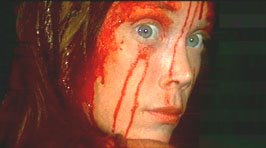
Shock It To Me! horror extravaganza last October at the head-scratching hour of 1PM. Much more appropriate is 11:59 PM, June 30, and the next night is one of my favorite midnight movies of all time, Brian DePalma's blood-transfused horror melodrama
Carrie. A good night to get some Hawaiian Punch at the concession stand. After this horror blow-out weekend (featuring an appearance by Elvira both nights), the Midnight Mass schedule brings less-scary (or is it just a different kind of scary?) films like
Beyond the Valley of the Dolls July 7-8,
Showgirls July 21-22, and
Death Race 2000 August 5th. Peaches also refrains from screening from video, as has become an increasingly
noted practice for midnight movies, except during her annual
Underground Short Film Festival (August 20th this year). Video is also how the
SF Neighborhood Theatre Foundation's
Film Night in the Park will present Hitchcock's post-Kennedy horror template
the Birds for free at Union Square September 9th, and classic horror spoof
Young Frankenstein at Dolores Park October 7, officially closing out Frisco's extended Summer.
And of course we just completed
Another Hole in the Head week at the Roxie, which happily coincided with the week-long break in the
Balboa's gargantuan Karloff festival. It wasn't
precisely a break, since Karloff's ghost appears in
the Spirit of the Beehive, Víctor Erice's stunning, every-frame-like-a-painting meditation on childhood fear and the irresistibility of film images that concluded a run Thursday night. But Erice's masterpiece is certainly something of a stretch as merely a Karloff-related film, like last night's
Gods and Monsters which was made twenty years after the star's death. A welcome stretch, as the films add even more diversity to a lineup that's already impressively ranged considering Karloff's image as a horror actor: the theatre's also showing him in comedies
the Secret Life of Walter Mitty and
the Boogie Man Will Get You (both this Sunday, June 18), gangster films
Night World (June 21) and
the Guilty Generation, and the tough but nuanced Howard Hawks prison drama
the Criminal Code. The latter two will show June 20, accompanied by an appearance from Karloff's Frisco-raised daughter Sara, who last week talked about her father's role in forming the Screen Actors Guild (his union card was #9), debunked his feud with Bela Lugosi, showed home movies (including the only known color footage of his get-up as the Monster in
Son of Frankenstein), and answered audience questions between
the Mask of Fu Manchu and
the Lost Patrol. But indeed the majority of the program is made up of Karloff's horror classics, including all the original
Frankenstein pictures that included him in the cast (his first two turns as the Monster play on today's double-bill, while his last, the aforementioned
Son of Frankenstein, closes the series June 22 alongside
House of Frankenstein, where Glenn Strange donned the monster's costume and Karloff got the mad doctor role), the original
the Mummy paired with a lesser-known Egypt-themed film
the Ghoul (June 19), and best of all, Edgar G. Ulmer's 1934 teaming of Karloff with Lugosi,
the Black Cat (June 21).
On Tuesday, June 6 I caught a triple-bill which showcased the diversity found even within Karloff's horror filmography. First up was the 1936
Frankenstein variant
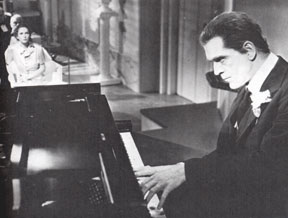
the Walking Dead, in which he gets to play an ordinary, sympathetic ex-con for a while before the character gets unjustly sent to the electric chair only to survive and become a zombified killing machine with a white streak added to his hairdo. As usual, director Michael Curtiz does very well with inherently cinematic setpieces like a shadow-laden jail cell or a piano recital in which Karloff gets to give the evil eye to the men who framed him, but the direction is less inspired when he's filming transitional scenes just trying to move the plot along. And unfortunately, the 16mm print the theatre had secured was judged to be unusable, so the screening was sourced from a 1979 LaserDisc release instead, which softened the deep blacks that undoubtedly should have been present in this German Expressionist-influenced film.
The 35mm black-and-white print for the second film, Robert Wise's 1945
the Body Snatcher, was just about perfect, however. And what a great film, seamlessly stitched together without the dull stretches found in
the Walking Dead. It's the tenth I've seen made by producer Val Lewton's RKO unit (the eleventh and last on my checklist is
Isle of the Dead, another one starring Karloff that I'd hoped might appear in this series when I first heard about it) during the early-to-mid 1940s. Like
I Walked With a Zombie,
the Seventh Victim and other Lewtons, it's a thoughtful, classy horror film with an exploitation-style title. In
the Body Snatcher Karloff is, if not the source of, than the leech-like enabler of evil in a corner of Old Edinburgh. The third film in the program was a very pleasant surprise: I was expecting to see
The Wurdalak, Mario Bava's 41-minute Tolstoy adaptation with Karloff as a vampire hunter bringing his very dangerous work home with him. But I'd come for the last show of the night, and the theatre treated us to the full
Black Sabbath (yes, the origin of the
heavy metal band's name) triptych it's a part of.
Black Sabbath was shown in the Americanized version put together by AIP for a 1964 release, and while the Italian-dubbed version is reportedly superior, this version is surely more appropriate for a Karloff tribute as it features his own voice, not only in
the Wurdalak, but in his introductions for all three segments. And it still shows off Bava's highly saturated colors and his visual trademarks: shots framed by lattice works, camera zooms, faces eerily peering through windows, etc.
Black Sabbath also was shown in a virtually pristine 35mm print.
Somewhat sadly, 35mm is increasingly becoming a cost-prohibitive option for making and distributing edgy, innovative new horror films these days. I wasn't able to make it to the Roxie for more than three films in the aforementioned Another Hole in the Head festival this year, but two of the three were shot digitally. And, like the problem with viewing horror at home or through a LaserDisc-sourced projection, the digital I've seen still does not reproduce dark enough blacks for my taste.
The Blair Witch Project worked in 1999 (I haven't revisited it since) because the digital video footage was convincingly combined with 16mm and carefully blown up to 35mm for its theatrical release, and more importantly because so much of its terror relied on the power of suggestion. But the digital look is a real problem for
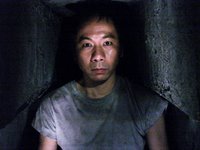
the Hamiltons, which embraces a 'reality TV' aesthetic seemingly appropriate to its subject matter: a family trying to cope with its special problems (the less you know about the specific horror elements before seeing the film, the better.) Unfortunately, it's just too bright a film to be scary, even when it's really trying to be. Shinya Tsuakamoto's
Haze fares better in its use of digital video. Like
Blair Witch, much of the horror I experienced stemmed from my imagination, as I concocted all sorts of scenarios to explain the protagonist/victim's claustrophobic predicament. And the extremely closed-in feel Tsukamoto chose to utilize would probably not have been possible to shoot with cameras large enough to hold a reel of celluloid film. I bet the film would be scarier still if screened from a more powerful digital projector than the one at the Roxie, which is perfectly fine for the documentaries its usually used for, but maybe not ideal for a more visceral film like
Haze.
I was glad that at least one of the Another Hole in the Head films was shot and presented on 35mm film (in a print that the festival spokesman apologized for as "dark" but I didn't find objectionable). And it was a good film too, combining scares, cultural commentary, and even a few laughs:
the Ghost of Mae Nak, the latest riff on a bedtime story known to every adult and child in Thailand. The tale of Mae Naak Phra Khanong, who died in labor while her husband was away at war, but who manifested as a ghost upon his return, has been made into a hit film by the Thai movie industry every few years or so, and since it was as long ago as 1999 that Nonzee Nimibutr's
Nang Nak surpassed
Titanic as that country's all-time box-office champion (only to be beaten in turn by Prince Chatri Chalerm Yukol's epic
Suriyothai in 2001), it's about time for another one. And it makes some sense that a foreigner (British cinematographer-turned-writer-director Mark Duffield) would tackle the next high-production value version; what Thai director would so blatantly ask to be compared to an industry powerhouse like Nonzee?
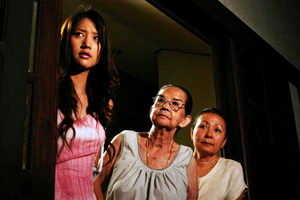
This was my first time watching a film made in the Thai language by a Westerner, and the outsider perspective definitely leads to certain divergences from what I'd normally expect from a Thai film. In bringing the story into a present-day setting (in which everybody seems just a bit out of date, which matches my experience with certain sections of Bangkok) the film centers on a young couple, Mak and Nak, who find themselves entwined into the legacy of the original Mae Nak when they move into a traditional teak house haunted by an angry ghost. But Mak and Nak do not seem to be aware of the legend, as it gets explained to them (and re-enacted for the benefit of the audience) midway through the film. A universe in which a Thai couple have never heard of Mae Nak Phra Kanong could only be one imagined by a storyteller, but that's okay, as Duffield is a pretty good one and his universe has its own rules. For example, the laws of physics do not necessarily apply to the human body when the opportunity for a cool-looking death scene special effect (and a nod to
Yojimbo) presents itself. But, and perhaps it's because I too have experienced Bangkok through outsider eyes, I thought Duffield captured the visual idiosyncrasies of the City of Angels (as the traditional Thai name of the city, Krung Thep, translates to) very well. I got the feeling that he shot scenes at some of the same ferry stops and pedestrian bridges that I passed through myself once or twice, though I know Bangkok is big enough that it's probably not true. I also thought it was interesting that the office of the shady, supernaturally-connected real estate agent was placed in Chinatown, which felt like a rebuttal, intentional or not, to the dozens of Hong Kong films (
the Golden Buddha and
the Eye being two) in which Thailand is portrayed as a source of crime and/or ghostly activity.


 Posts


