 Last Thursday the Mill Valley Film Festival opened, and with it a run of forty-five straight days of the thus-far foreseeable future where there will be a minimum of one film festival happening somewhere here on Frisco Bay every single day. According to the running list on this blog's right-hand sidebar, on most days there will be three or four festivals running somewhere in the area, and on a few as many as six or seven! It's a testament to the vitality of Frisco Bay audiences for movies outside the usual multiplex offerings that so many festivals can co-exist year after year in the same month-and-a-half period. But tickets sell briskly for many of these festivals, and it's worth obtaining them in advance if there's a particular film you're set upon seeing. There are still (pricey) tickets available for the MVFF closing night film gala The Artist this Sunday. I've seen it, and though it couldn't possibly live up to my expectations after its triumphantly successful screenings in Cannes and Toronto, I do think it will charm just about anybody else who watches it, and I'm not alone in hoping will function as an evangelizing force for the authentic silent film art that I so dearly love. Unfortunately, tickets to an MVFF feature I liked even better have been at "rush status" for over a week: tonight's screening of Pina, which is the best Wim Wenders film in in years if not decades. At least in my case, it's definitely an evangelizing force for choreographer Pina Bausch, who I previously knew next to nothing about, and for 3-D presentation of great dance. I'd certainly pay to see full versions of some of the works excerpted in Pina on a local 3-D screen.
Next to open are this weekend's Arab Film Festival (Jonathan Curiel has an article on Muslim lesbian drama Three Veils), the South Bay's Poppy Jaspar Short Film Festival, and the 10th annual edition of DocFest, which is called "SF's quirkiest festival" in Cheryl Eddy's new Guardian preview. And the San Francisco Film Society's Fall Season enters its next phase with Taiwan Film Days. I understand that the sf360 website is going to publish my writing buddy Adam Hartzell's preview of this mini-festival's selections imminently. In the meantime he has generously offered a piece on a film playing this Saturday and Sunday,Pinoy Sunday, for Hell On Frisco Bay. Here's Adam:
 Ho Wi-ding's Pinoy Sunday is one of those films I watch while preparing a festival primer that has me itching to write more about it than a primer will allow. It isn't a brilliant film, but it is a fairly entertaining one that touches on issues I wish more films explored, in this case, the lives of migrant workers. And considering it's a Taiwanese film, (although with production help from the Philippines, Japan, and France, and a Malaysia-born director), I'm particularly happy to see the film highlight migrant issues unique to Taiwan, specifically the lives of Filipino migrant laborers in Taiwan. Along with the particular, Pinoy Sunday also enables more general discussion of the lives of migrants regardless of where they toil.
Pinoy Sunday follows two Filipino migrant laborers, Dado (played by Bayani Aqbayani) and Manuel (Jeffrey Quizon). Dado has a family back home but a girlfriend in Taiwan, posing an ethical quandary he seeks to resolve early on in the film. Manuel is the wanna-be playboy who puts up a good front to survive the romantic rejection he receives. He also is a bit of a player when it comes to the rules of the factory where he works, particularly the factory's curfew. Arriving on occasion just after the curfew, he is able to finagle his way around possible deportation from such violations of his contract by slipping the Taiwanese guard some betel nut for his troubles.
Besides his playboy dreams, Manuel has another simpler dream. He wants a couch, a sofa, (or what my grandmother called a davenport), for the top of their factory dormitory where they can sit and drink beer after a long day of manual labor. As Manuel and Dado recover from opposite ends of romantic rejection (Manuel the rejected, Dado the rejecter) in a public park, they stumble on an abandoned sofa. They begin their journey to take this sofa back to their dorm before curfew, a journey that has them at each others throats as well as discovering a deeper bond. They find kindness where it wasn't expected, along with finding themselves mistaken for heroes, thieves, and Indonesians.
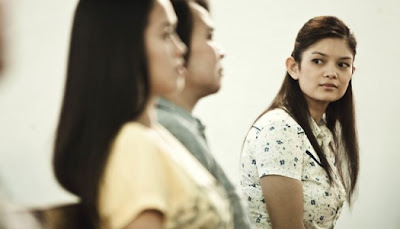 Since Hell on Frisco Bay caters to the San Francisco Bay Area, most readers here are likely familiar with the slang term 'Pinoy'. Some may also be familiar with some of the controversy around the term. North Americans of Filipino descent often use the term affectionately, but some from the Philippines still hear the term tied up to ridicule from U.S. soldiers before and during World War II. In this film, as evidenced on his t-shirt worn early on in the film, Manuel wears the moniker with pride. (This same scene where the t-shirt is introduced also underscores a class/race transportation divide in that all the Filipino migrant workers are riding bicycles, perhaps made at the very factory where Dado and Manuel work, in contrast to the ubiquitous presence of the motorized scooter ridden by many, many Taiwanese.) The 'Sunday' in the title represents to the single day of the week many migrant factory workers in Taiwan tend to get off. The key words there are 'factory workers', since domestic laborers, mostly female and many Filipina, often do not get their Sundays off, or any day off at all. In Pinoy Sunday, Dado's girlfriend Anna, (played by Meryll Soriano), underscores this point in a nicely nuanced way. At first, you might assume she gets her Sundays off too because she and Dado meet up every Sunday at church. But then why is the elderly woman for whom Anna is a caretaker always with her? As much as Anna might get to do what she wants on Sunday, she still has to bring her ward with her. The ward is portrayed as mute, rather than demanding and difficult, partly as a means to contain the plot. But I find the nuanced portrayal here poignant. It hints at the conditions and differences between how gender is policed in the lives of migrant laborers rather than pummeling us over the head with it. (For those who want to explore that particular issue in more detail, check out an article from National Taiwan University professor Pei-chin Lan's available as a pdf here.)
Besides wrapping up issues faced by Filipino migrant laborers in a tight little title, there are other scenes particular to the transience of the migrant experience. There is the mall specifically catering to needs of Filipinos/Filipinas. These malls are often only open on the weekends. In these malls you will find restaurants serving Filipino food and the ubiquitously Filipino balakbayan box stores that send goodies back to families in the Philippines. A couple other issues the film highlights are the serious ramifications of violating curfew and the moment they are mistaken for Indonesian. According to Lan, the Council of Labor Affairs "dictates that a migrant worker can work for only one particular employer during a stay in Taiwan." There are some specific exceptions to this, but failure to make curfew at the factory could result in being sent back to The Philippines, and this strict policing of bodies is demonstrated at the very beginning of the film, when Dado runs into a fellow Filipino washing his face in the airport bathroom while still in handcuffs, escorted all the way to the airport gate to be sure he is deported. Such policing also confronts Manuel when a colleague is caught while on the lam. Another matter detailed in Lan's article is how Indonesian and Filipino migrant workers are played off each other in media stereotypes of fabricated essential natures. This makes the moment in Pinoy Sunday when the media mistake Dado and Manuel for Indonesian a much more layered critique, and the peppering of accusations upon brown bodies all the more poignant, as the film helps the political medicine go down by playing up the comedy involved in such outlandish media theatre.
One of my problems with Pinoy Sunday is the ending. But for spoiler-avoidance I won't go into how the ending ignores global economic realities otherwise prominent in the film. I understand this film doesn't want to be a serious downer. It wants to entertain, to show respect for migrants who too often go ignored. So I won't harp on Pinoy Sunday too much since it does bring to the attention of Taiwanese audiences some of the plights of those brought into Taiwan in order to make their economy work in ways more privileged citizens demand.
 In its portrayal of present Taiwan (Film) day reality, Pinoy Sunday avoids being The Help. As Noy Thrupkaew so expertly critiques in The American Prospect, The Help may "peep into the past" of American injustices, but without any hint that that past is still with us in the present treatment of domestic workers in the U.S. (now more likely Latina than African-American). But it takes a movie like this to inspire a great (yet underappreciated) writer like Thrupkaew to school us on the lives of domestic workers in the U.S. today, so I'm glad The Help is out there hoping viewers smitten by it might stumble onto Thrupkaew's online history lesson. Pinoy Sunday may not confront all the issues of Filipino migrant laborers in Taiwan, but it confronts nonetheless, while staying more entertaining than didactic, which might make all the difference regarding its ability to reach folks who sequester themselves off from facing up to economic realities.
 Not long ago I sat down for an interview with one of last year's honorees, the amazing, undervalued chronicler of music, cuisine, and the cultures encircling and encircled by them both, Les Blank. The interview was for an article to be published in the next issue of First Person Magazine, entitled "Radical Foods". When editor Betty Nguyen told me of this theme, Blank came to mind immediately as an ideal person to get involved. One of the most unique aspects of his filmmaking is his integration of food into the presentation of his films, as I experienced several years ago at a screening of his 1980 film Garlic Is As Good As Ten Mothers. Here's Blank's response to my question about the difference between "Smell-O-Vision" and "Aromaround":
John Waters had scratch and sniff cards. I didn't care for that myself. No one I know has the actual food being cooked in the actual theatre. When I'd screen Always For Pleasure and cook red beans and rice, I'd call that Smell-Around. If I was showing Yum Yum Yum or Spend It All, which has gumbo in it, I would call it Smell-Around too. But the garlic film, I'd always call Aromaround.
With the garlic film you put toaster ovens in the front or the rear of the theatre, and then you turn on the oven to 350 degrees. If you turn it on in the beginning, the smell will be full strength about halfway through, about 20-25 minutes in. I like it best when it hits its peak when Alice Waters says "can you smell the garlic?" The audience might yell back. It might laugh, or sigh.


 Posts
Posts


